
 Canada EN
 Mexico ES
CRC Industries Customer Success Story
Resulting in Estimated Annual Savings of $30,654 (€26.794) per year
Table of Contents:
Customer Challenge | CRC Brand Solution | Customer-Reported Results | Numbers for This Case | Savings Calculation
Customer Challenge
Company Overview: A pork-processing facility in Spain runs continuous conveyor and mixing operations to move product through cutting, mixing, and packaging. As in any food operation, uptime and hygiene go hand in hand — every lubricant used near the product line must keep performing under constant washdown while resisting the contamination that a wet, tacky film tends to attract. It also needs to leave behind a protective anti-corrosion layer.
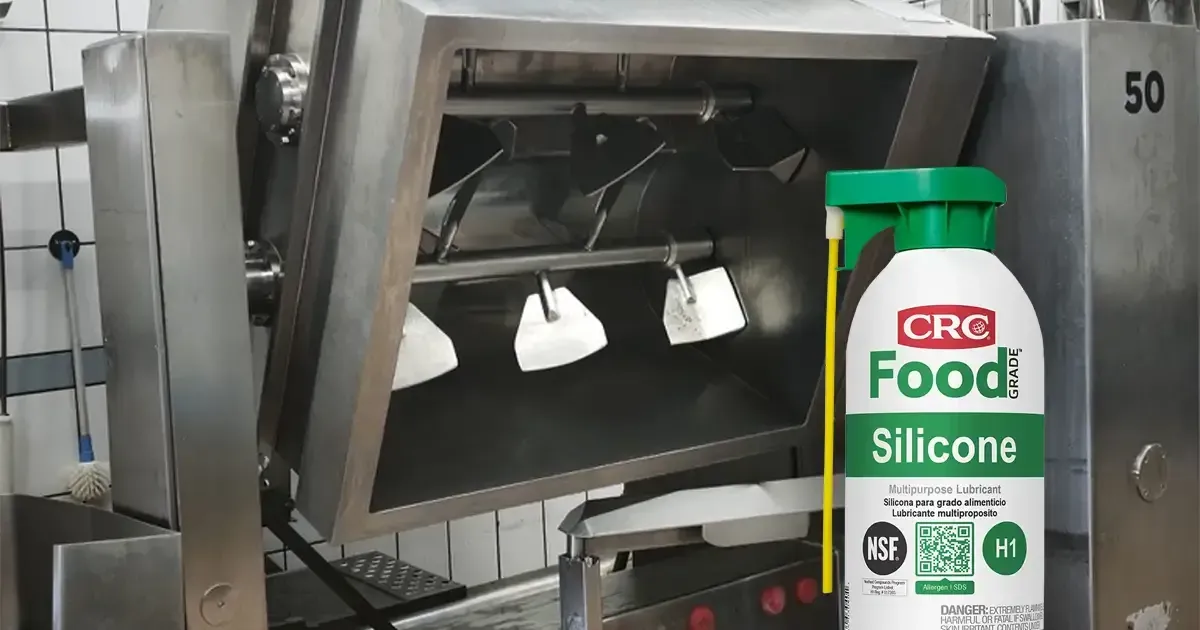
The Challenge: On one production line, a drive chain running in a mixer that moves 600 kg of meat per cycle was continuously exposed to water, salt, and product splashes. The competitive product was a multipurpose lubricant that left a wet film, holding contamination and forming an abrasive paste that accelerated wear and caused recurring chain failures. Humidity in the work environment also caused corrosion on the chain, adding to the challenge.
Each failure stopped the line — reportedly around 4 failures per year — with at least 2 days of downtime per incident for lockout, replacement, sanitation, and restart, including 20 hours of labor at $28 (€25) per hour. Every six months, chain failure also caused the mixer paddles to collide, requiring paddle reconditioning at a cost of $4,576 (€4,000) and 10 additional work hours.
Beyond the cost of each failure — including the $915-$1,029 (€800–900) chain replacement cost and $572 (€500) for replacement bearings and seals — the larger expense was lost production during every stoppage. Each incident was estimated to interrupt two mixer cycles, or 1,200 kg of production, plus indirect costs such as stoppages on other lines and missed customer delivery commitments.
Working through the numbers together, it became clear that the recurring interruption — not the price of the part — was the true cost of the problem.
CRC Brand Solution
CRC FG Silicone — NSF H1 Registered Dry-Film Silicone Lubricant
The Solution: CRC recommended switching to CRC FG Silicone, the specific food-grade silicone lubricant used in this application. Unlike a wet oil, CRC FG Silicone forms a clear, dry, non-tacky silicone film and is NSF H1 registered for incidental food contact, making it well suited for food-processing environments where lubrication performance and hygiene both matter.
The dry film leaves behind a protective layer that sheds water and does not attract salt, particulate, or product residue — exactly the failure mode behind the chain breaks. Because the application called for a clean, dry film rather than a heavier oil that traps contamination, CRC FG Silicone was the right chemistry for the line’s operating conditions. Today, the facility lubricates the chain once every 15 days, and after more than a year of using CRC FG Silicone, it has not experienced another chain failure.
Product Highlight: CRC FG Silicone
In this story, the product is not just “a silicone spray” — it is CRC FG Silicone, a food-grade dry-film silicone lubricant designed for food-processing and handling applications. It forms a colorless, odorless, non-staining film that helps reduce binding and sticking while protecting metal and non-metal surfaces.
Why it mattered here: Its NSF H1 registration supports use where incidental food contact may occur, while the dry, non-tacky film helped avoid the wet contamination buildup that had been accelerating chain wear.

Numbers for This Case
Since switching to a simple application of CRC FG Silicone every 15 days in place of reacting to recurring chain breaks, the customer reports:
- Reduced Downtime: chain failures dropped from about 4 per year to roughly less than 1 per year, removing the recurring line stoppages tied to lubrication.
- Cleaner Operation: the dry silicone film sheds water and salt instead of holding it — no more abrasive buildup from old lubricant and contamination.
- Reliable Equipment Performance: the chain now runs on a predictable 15-day maintenance routine rather than failing unpredictably mid-shift.
- Estimated Cost Savings: approximately $30,654 (€26.794) per year, driven mainly by avoided downtime rather than avoided part cost.
“Having the right lubricant on this line really saved us time and money — now the chain just keeps running.”
— Luis Lodoño, Maintenance Manager, Pork-Processing Facility (Spain)
Numbers for This Case
The customer provided and confirmed the following figures, which were used to estimate the annual savings achieved by implementing this solution.

Savings Calculation
Avoided annual failure cost: $2,288 + $9,153 + $572 + $286 + $9,610 + $6,864 + $4,118 = $32,891
(€2.000 + €8.000 + €500 + €250 + €8.400 + €6.000 + €3.600 = €28.750)
Annual CRC Silicone cost: $932 per application x 24 applications per year = $2,237
(€81,5 per application × 24 applications per year = €1.956)
Estimated annual savings: $32,891 - $2,237 = $30,654
(€28.750 − €1.956 = €26.794 / year)
